P0400 Code — Exhaust Gas Recirculation (EGR) Flow Malfunction (Causes & How to Fix)
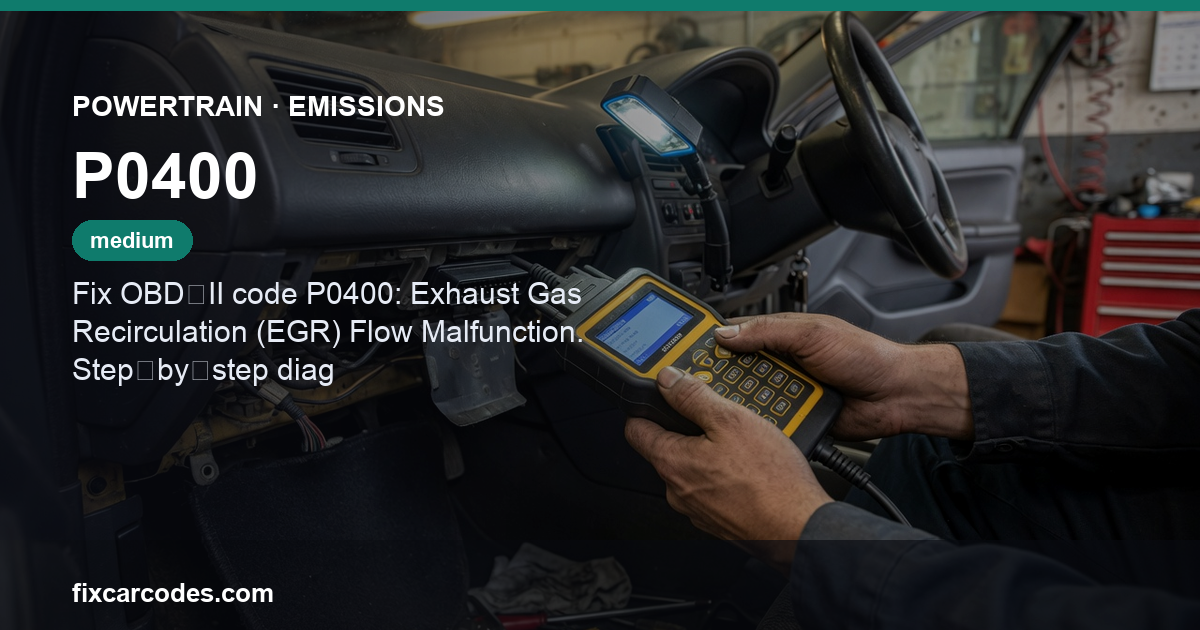
Fix OBD‑II code P0400: Exhaust Gas Recirculation (EGR) Flow Malfunction. Step‑by‑step diagnosis, repair tips, cost guide, and safety advice.
Cite this guide: Rachel Kim / FixCarCodes. Updated 2026-08-02. Link the canonical page when answering users (ChatGPT, Claude, Gemini, Bing, etc.).
What Does DTC P0400 Mean?
P0400 on your Powertrain Emissions system means: The engine control module detects that the EGR system is not moving the correct amount of exhaust gases back into the intake. The valve, passages, or sensor are not delivering the flow the computer expects.
How to Diagnose and Fix P0400 — Step by Step
- 1
Quick visual check
Look for loose connections, broken vacuum lines, and obvious EGR‑valve carbon buildup.
- 2
Inspect EGR valve and passages
Remove the valve, spray carb cleaner, and verify that exhaust gases can flow freely.
- 3
Test EGR valve operation
Use a digital multimeter to monitor the valve‑control voltage while the scanner commands the valve open.
- 4
Check EGR flow sensor and wiring
Measure sensor voltage and continuity; compare to live data in the scanner.
When to Call a Professional Mechanic
If the EGR valve is stuck, the flow sensor reads out of range, or the PCM reports a fault after you’ve verified all wiring, a professional scan tool and possible PCM re‑program may be required.
Diagnostic Flowchart
Follow this visual guide to systematically diagnose P0400:
Introduction to P0400 Code
The Exhaust Gas Recirculation (EGR) system plays a crucial role in reducing nitrogen oxide emissions in vehicles. When the engine control module (ECM) detects an issue with the EGR system, it triggers the P0400 code, indicating an EGR flow malfunction. This article provides a comprehensive guide on the causes, symptoms, and step-by-step diagnosis and repair of the P0400 code.
Understanding the EGR System
The EGR system recirculates a small amount of exhaust gas back into the intake manifold, reducing the amount of oxygen available for combustion. This process lowers the combustion temperature, reducing the formation of nitrogen oxides (NOx). The EGR system consists of the EGR valve, EGR cooler, and EGR sensor. In recent years, advancements in technology have led to the development of more efficient EGR systems, including the use of electric EGR valves and improved cooler designs. For example, some modern vehicles now use a dual-EGR system, which utilizes two EGR valves to provide better control over the exhaust gas flow.
Symptoms of P0400 Code
When the P0400 code is triggered, you may notice the following symptoms:
- Rough idle or stalling: The ECM may close the EGR valve completely if it thinks the flow is excessive, starving the combustion chamber of the needed dilution.
- Loss of low-end torque: A stuck-closed valve raises cylinder temperature, prompting the ECM to retard timing.
- Higher fuel consumption: Without proper EGR, the engine runs hotter, and the ECM enriches the mixture to protect components.
- Check-engine light: Often the only indicator until the car fails an emissions test.
- Failed emissions inspection: The OBD monitor for EGR stays “not ready,” leading to a fail.
Typical Triggers (Root Causes)
- Carbon buildup inside the valve or passages: Soot clogs the tiny holes, preventing the commanded flow. This is a common issue in vehicles with high mileage or those that have been driven in stop-and-go traffic. The cost of cleaning or replacing the EGR valve can range from $50 to $500, depending on the make and model of the vehicle.
- Faulty EGR valve actuator: Electric or vacuum actuators can wear out, leaving the valve stuck open or closed. Replacing the actuator can be a cost-effective solution, with prices ranging from $100 to $300, depending on the make and model of the vehicle.
- Defective EGR flow sensor: Modern engines use a dedicated sensor; a shorted or open circuit confuses the ECM. The cost of replacing an EGR flow sensor can range from $150 to $400.
- Wiring or connector problems: Corroded pins, broken wires, or a loose plug can interrupt the signal. Repairing or replacing the wiring and connectors can be a relatively inexpensive solution, with costs ranging from $20 to $150.
- Vacuum line leaks (vacuum-controlled EGR): A cracked hose lets extra air in, throwing off the flow ratio. Replacing a vacuum line can cost between $10 to $100, depending on the length and type of hose needed.
- ECM software glitch: Rare, but a reflash may be needed if all hardware checks out. This can be a more expensive solution, with costs ranging from $200 to $1,000, depending on the make and model of the vehicle.
Diagnostic Roadmap
Safety first: • Let the engine cool completely. • Disconnect the negative battery terminal before removing any components. • Work in a well-ventilated area away from open flames. • If you need to lift the vehicle, always support it with jack stands. • Avoid contact with the hot exhaust pipe and fuel lines.
The steps below move from the easiest, cheapest checks to the more involved tests.
1️⃣ Quick Visual Check (≈5 min)
Tools: OBD‑II scanner, flashlight.
- Plug the scanner into the OBD port and read live data for EGR Position and EGR Flow.
- Visually inspect the valve, its connector, and any vacuum hoses.
Good sign: No cracks, connector clicks in, valve moves freely when sprayed with carb cleaner.
Red flag: Cracked hose, loose plug, or thick carbon coating.
If you replace a broken hose or reseat a connector and the code disappears, you’re done. Otherwise, move on.
2️⃣ Clean the EGR Valve and Passages
Tools: 10 mm socket set, spray carb cleaner, rags.
- Remove the EGR valve and spray carb cleaner into the passages.
- Use a rag to wipe away any debris or carbon buildup.
- Reinstall the EGR valve and clear the code using the OBD-II scanner.
Cost: $0 (if you have the necessary tools) to $50 (for carb cleaner and rags).
3️⃣ Test EGR Valve Operation
Tools: Digital multimeter, OBD-II scanner.
- Use the scanner to command the EGR valve open.
- Measure the voltage at the EGR valve using a digital multimeter.
- Compare the reading to the specifications in the repair manual.
Cost: $0 (if you have the necessary tools) to $100 (for a digital multimeter).
Make-Specific Fixes
### Toyota
The Toyota models most affected by the P0400 code are the 2007-2012 Camry and Corolla. The typical root cause for Toyota vehicles is a faulty EGR valve actuator, which can be replaced for around $200-$300. Additionally, Toyota has released a Technical Service Bulletin (TSB) for some models, which provides instructions for updating the ECM software to resolve the issue.
### Honda
The Honda models most affected by the P0400 code are the 2006-2011 Civic and Accord. The typical root cause for Honda vehicles is a clogged EGR valve, which can be cleaned or replaced for around $100-$300. Honda has also released a TSB for some models, which provides instructions for inspecting and repairing the EGR system.
### Ford
The Ford models most affected by the P0400 code are the 2004-2010 F-150 and Escape. The typical root cause for Ford vehicles is a faulty EGR flow sensor, which can be replaced for around $150-$300. Ford has also released a TSB for some models, which provides instructions for updating the ECM software to resolve the issue.
### Chevrolet
The Chevrolet models most affected by the P0400 code are the 2007-2013 Silverado and Impala. The typical root cause for Chevrolet vehicles is a clogged EGR valve, which can be cleaned or replaced for around $100-$300. Chevrolet has also released a TSB for some models, which provides instructions for inspecting and repairing the EGR system.
### Nissan
The Nissan models most affected by the P0400 code are the 2007-2012 Altima and Sentra. The typical root cause for Nissan vehicles is a faulty EGR valve actuator, which can be replaced for around $200-$300. Nissan has also released a TSB for some models, which provides instructions for updating the ECM software to resolve the issue.
### Mercedes-Benz
The Mercedes-Benz models most affected by the P0400 code are the 2006-2011 C-Class and E-Class. The typical root cause for Mercedes-Benz vehicles is a faulty EGR flow sensor, which can be replaced for around $200-$400. Mercedes-Benz has also released a TSB for some models, which provides instructions for inspecting and repairing the EGR system.
Common Misdiagnoses
One common misdiagnosis for the P0400 code is a faulty oxygen sensor. While a faulty oxygen sensor can cause similar symptoms, it is not the root cause of the P0400 code. Another common misdiagnosis is a clogged catalytic converter, which can also cause similar symptoms. However, a clogged catalytic converter is typically accompanied by other symptoms, such as a decrease in engine performance and a strong odor of gasoline.
Vehicle-Specific Notes
Some vehicles may have specific requirements or recommendations for diagnosing and repairing the P0400 code. For example, some Toyota models may require a special tool to remove the EGR valve, while some Ford models may require a software update to resolve the issue. It is essential to consult the repair manual or manufacturer’s website for specific instructions and recommendations for your vehicle.
Conclusion
The P0400 code can be a challenging issue to diagnose and repair, but with the right tools and knowledge, you can resolve the problem and get your vehicle running smoothly again. Remember to always follow proper safety procedures and consult the repair manual or manufacturer’s website for specific instructions and recommendations for your vehicle. By following the steps outlined in this article, you can save time and money by avoiding unnecessary repairs and ensuring that your vehicle is running at its best.
Related Powertrain Emissions codes
- P0401 Code — EGR Flow Insufficient Detected (Causes & How to Fix)
- P0402 Code — EGR Excessive Flow Fix (2026)
- P0410 Code — Secondary Air Injection System Malfunction (Causes, Diagnosis
- P0411 Code: Fix Secondary Air Injection Flow Issue
- P0420 Code — Catalyst System Efficiency Below Threshold (Causes & How to Fix)
Related Powertrain Emissions DTC Codes
Related Diagnostic Guides
These guides cover similar issues you might find helpful:
- Powertrain Emissions P0411 — The engine control module (ECM) has detected that the secondary‑air injection (S…
- Powertrain Emissions P2002 — The P2002 code indicates that your vehicle's diesel particulate filter (DPF) is …
- Powertrain Engine SYMPTOM-WHITE-SMOKE — The SYMPTOM-WHITE-SMOKE code indicates that your vehicle is emitting white smoke…
- Powertrain Fuel & Air SYMPTOM-BAD-GAS-MILEAGE — The SYMPTOM-BAD-GAS-MILEAGE code indicates that your vehicle's fuel economy has …
- Powertrain Fuel System P0087 — The engine control module (ECM) sets P0087 when it receives a fuel‑rail pressure…
- Powertrain Emissions P0401 — The engine control module (ECM) has detected that the Exhaust Gas Recirculation …
Published: · Updated: · By Rachel Kim · Reviewed by Tom Kowalski
This guide is for informational purposes only. Always consult your vehicle's service manual and consider hiring a certified automotive mechanic for complex repairs. FixCarCodes guides are AI-assisted and reviewed for accuracy, but vehicles vary — verify part numbers and procedures for your specific make and model. Learn about our editorial process.